

AI Enhanced Odor Sensor
Detection and Measurement of Odors
Easy Training and Adaptation
Objective Data for Complaint Management
Suitable for Temporary and Permanent Installations
Unpleasant odors in buildings can quickly lead to complaints, yet objectively measuring such emissions has long been a challenge. A sensor from Bosch Sensortec, enhanced with machine learning capabilities, can be trained to detect specific odors—turning subjective perceptions into reliable, quantifiable data.
Originally developed to identify spoiled produce in refrigerators, the sensor is now also employed as an early warning system for wildfires.
Transferred to the context of technical building services, it enables a wide range of applications, including the monitoring of kitchen and restroom exhaust systems, waste collection areas, and the early detection of smoldering components in control cabinets and technical hubs.
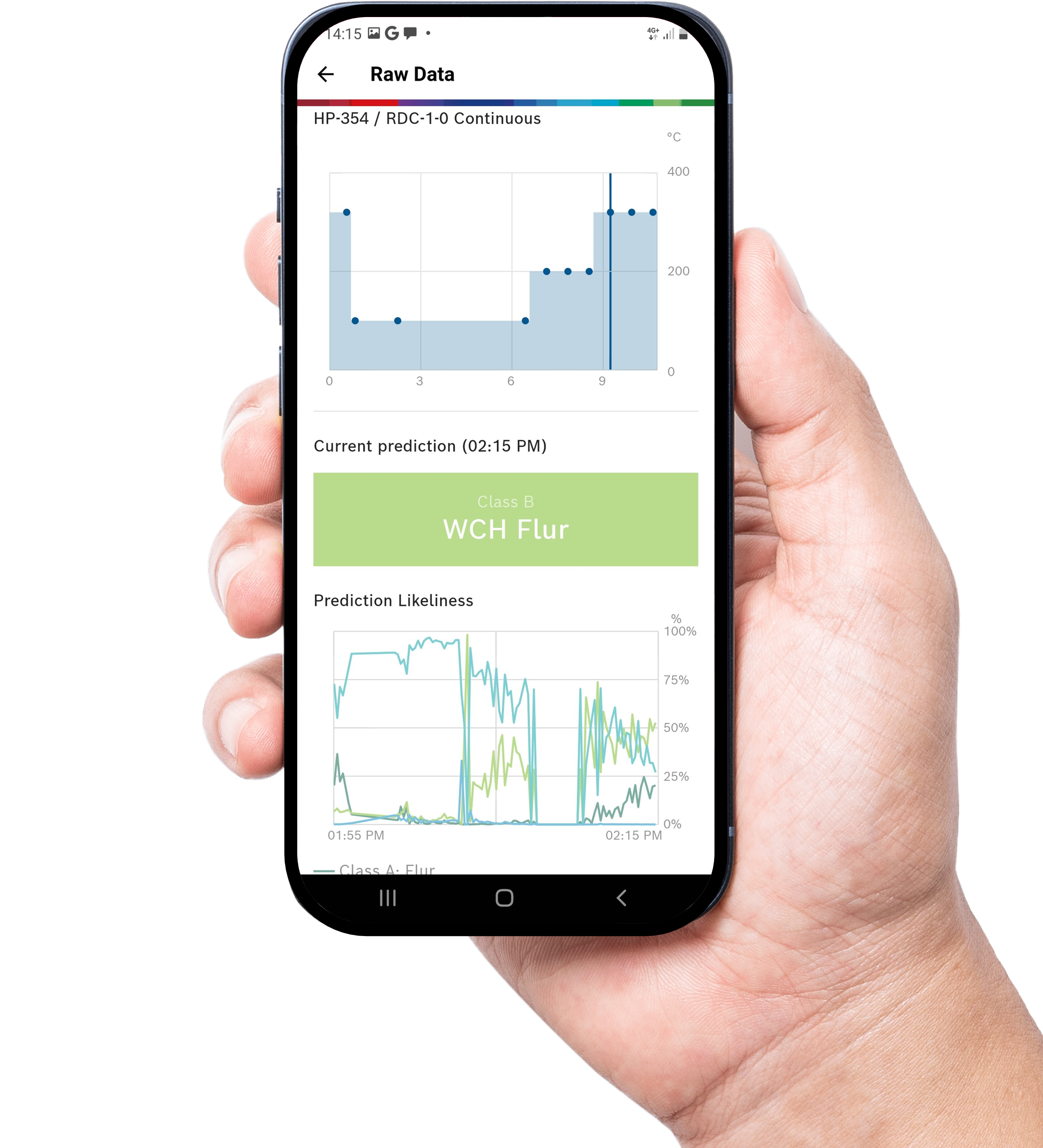
For training, the sensor board is connected to a power bank and exposed to the affected air on site. Using a mobile Android app, sampling is initiated for around 20 minutes and labeled for later analysis. Afterwards, a baseline must be recorded—“normal” air, ideally from the same room but without any disturbing odors.
With the collected data, the actual training takes place on a laptop. In just a few steps, a neural network learns to reliably distinguish between the two recorded states. Once the trained model is transferred back to the sensor board, it can display the current state in “live test” mode—for example, “Normal” or “Wastewater.”
In one building operated by SPIE, this approach successfully identified the source of odors in a problematic restroom, proving that the sensor can even differentiate more subtle concentrations.
In the future, the sensor is also intended to complement existing gas detection systems. This would allow false alarms, triggered by cross-sensitivities to other substances in the building, to be better evaluated—enabling staff to make more informed decisions.
A single sensor can be trained to detect up to four different odors simultaneously, which is sufficient for many use cases. For additional detection states, another sensor can simply be added.
This solution is a prime example of how the capabilities of existing technology can be impressively expanded through the use of artificial intelligence.




IHR KONTAKT/ YOUR CONTACT
SPIE GERMANY SWITZERLAND AUSTRIA

Clarissa Hack
Leiterin/ Head of Digital Transformation
clarissa.hack@spie.com