

Digital Surveying and Documentation of House Connections with NAVA

Currently, house connection surveys are performed manually using measuring tapes, rulers, and sketches, which then require back-office processing and digitization.
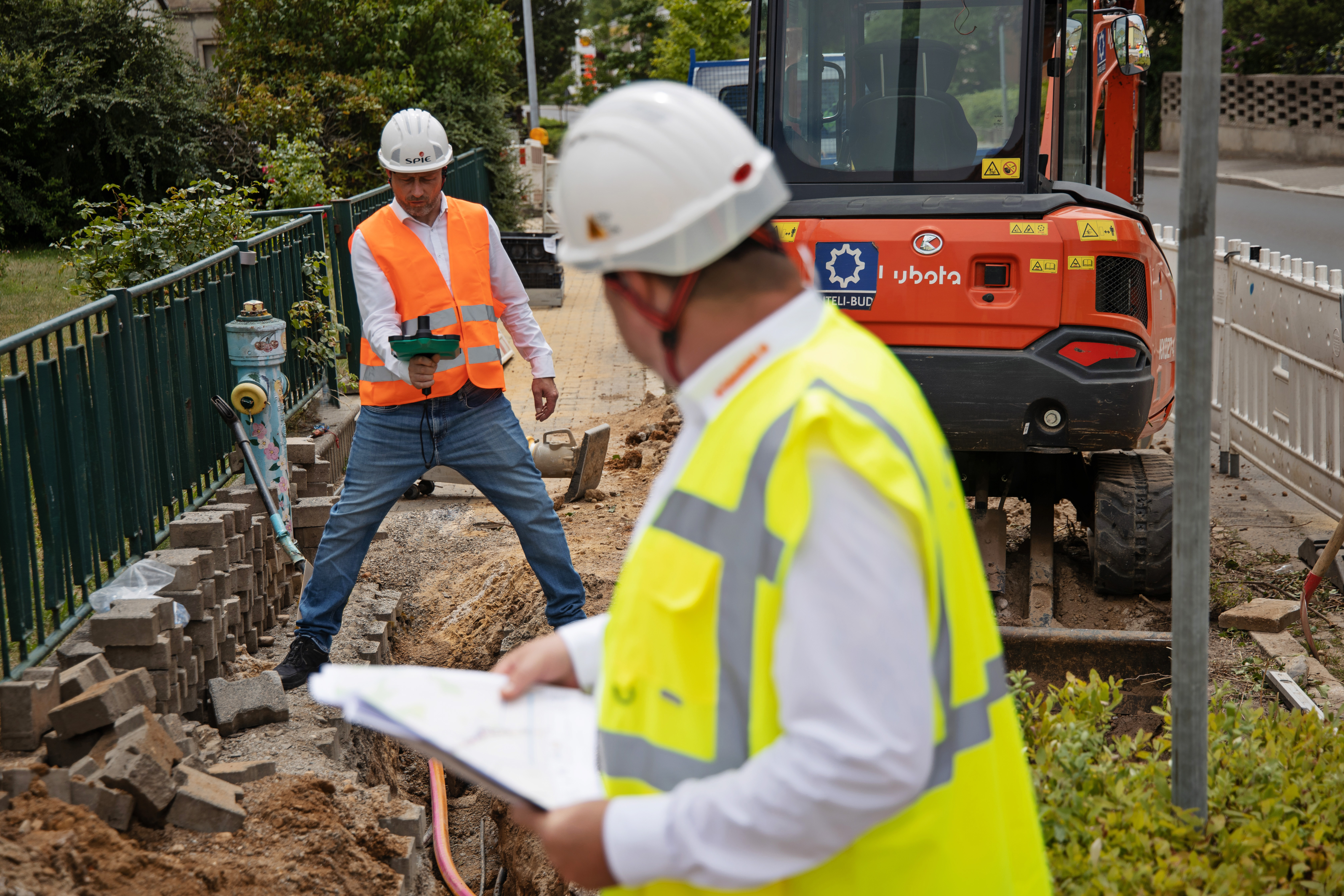
With the NAVA app, manual work is eliminated. Field staff can scan their surroundings with a smartphone to digitally mark reference points on-site. They can photograph individual points along exposed trenches, repeat measurements in verification mode, and document the process. The quality of each survey can be checked immediately on-site.
NAVA automatically generates a site sketch including all relevant component details and attribute data in real time and transfers this information for back-office processing. Surveying tasks are managed, assigned, and finalized via the NAVA Manager, an online platform.





Thanks to NAVA, a fully paperless and end-to-end digital process is now possible. Transmission errors from analog to digital as well as long waiting times for digitizing hand-drawn sketches are a thing of the past. Time-consuming tasks like redrawing sketches or clarifying missing measurements are eliminated, making the entire workflow significantly more efficient.
Accuracy and quality of documentation are crucial for NAVA’s success. In Germany, documentation standards for electricity, gas, and water networks are defined by specific regulations (VDE-AR-N-4201 and DVGW GW 120). With the updated documentation framework from December 2021, NAVA can now be used as a photogrammetric surveying method.
By utilizing sensors, it is now possible to directly capture GNSS coordinates to supplement the surveying documentation. This enables precise measurement of longer pipeline sections. The captured GNSS data can be easily integrated into GIS mapping systems used by utilities or other network operators.

Regulation-compliant documentation
Resource and time savings
Standardization of survey data
High customer satisfaction
Intuitive, user-friendly operation

IHR KONTAKT / YOUR CONTACT
SPIE GERMANY SWITZERLAND AUSTRIA

Clarissa Hack
Leiterin / Head of Digital Transformation
clarissa.hack@spie.com