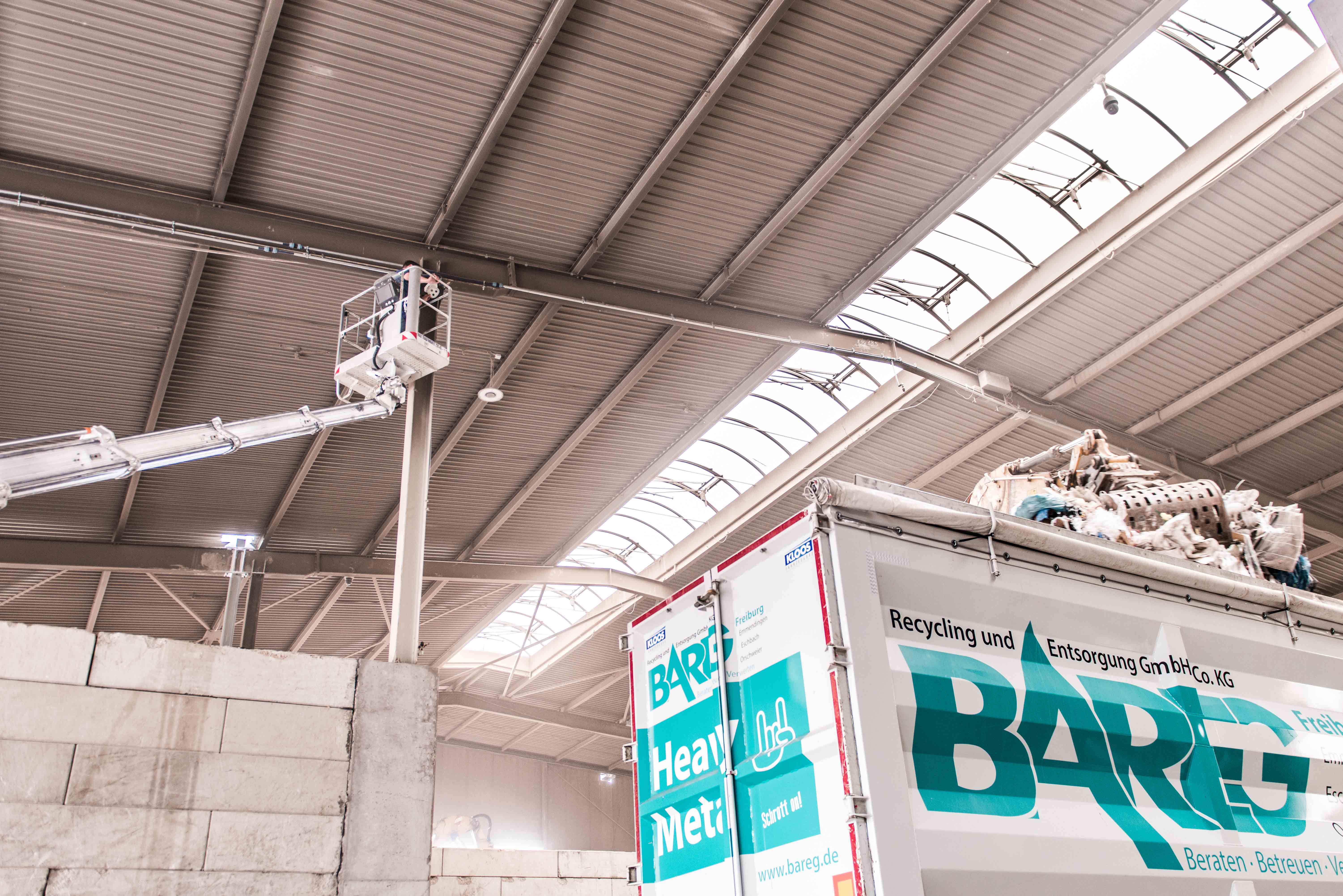


Freiburg, 27 June 2022 – SPIE, the independent European leader in multi-technical services in the areas of energy and communications, has been commissioned by Bareg Recycling und Entsorgung GmbH & CO. KG to equip three of its waste disposal plants with thermal cameras. The cameras are designed to monitor the facilities over a wide area so that any unusual build-ups of heat that could potentially lead to fires among the mountains of waste can be detected early on.
Preventive fire protection under challenging conditions
Fire protection plays an especially important role in the waste disposal industry, where a classical fire alarm system can provide complete protection only with major constructional outlay. This is why the recycling company Bareg instead started to look for a fire protection monitoring system that was both flexible and highly efficient.
To fulfil these requirements, the team from the Information & Communication Services operational division of SPIE Deutschland & Zentraleuropa presented a solution involving thermal cameras: “We put the technology through its paces first and quickly saw the significant added value it offered in terms of fire safety in our operational processes,” said Uwe Minder, Bareg’s head of IT. The system was then installed at three locations. “This system offers outstanding value for money and is highly flexible”, says Walter Müller, the security technology team leader in the Information & Communication Services operational division of SPIE Deutschland & Zentraleuropa. “The brains of this early fire detection and alarm system are located in the camera. No server or video management software is required”, continues Müller.
A particular challenge for the thermal imaging cameras is posed by the extreme conditions under which they need to be capable of operating with complete reliability. SPIE’s team tackled this problem by ensuring that the cameras were expertly positioned. The entire operational process is data-protection-compliant at all times because the thermal images do not permit the clear identification of people.
Around the clock: automatic monitoring – including remotely
The usual processes of fermentation that occur in piles of waste as well as batteries and gas cylinders that are disposed of illicitly, pose a potential fire hazard for waste disposal companies. Furthermore, the half-open buildings at the waste disposal plants are exposed to the weather and can develop large amounts of dust, making the monitoring conditions all the more challenging. Nevertheless, monitoring has to take place continuously. In the system installed for Bareg, each camera reliably monitors the surface temperature over an area of more than 800 square metres around the clock. Bareg’s security team uses the camera images as a conventional video surveillance system with thermal images.
In addition, the warning process can also be automated, allowing monitoring to be performed remotely. As soon as the defined temperature limit is exceeded, the system triggers a chain of defined processes for alerting the security team. The emergency team can then switch to the system and monitor the situation via a live stream. “In waste disposal plants, fire poses a major hazard to people, buildings and material assets. This automated early fire detection concept from SPIE is extremely effective and meets all our standards,” says Uwe Minder. “We are delighted with this successful innovation and hope that our partnership with Bareg will continue to grow in the future,” says Jürgen Krause, head of the branch responsible at SPIE Information & Communication Services in Karlsruhe.