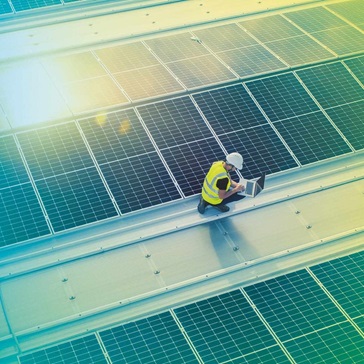


Solar carports in Poland
According to our expert Grzegorz Pióro, when covered with solar panels, a car park for 500 to 1000 cars has the potential to generate enough solar power to cover three quarters of the facility’s needs. Solar roofs have other benefits as well: besides producing electricity, they protect the vehicles against rain, snow and sunlight. And they don’t take up open space as solar panels on green spaces do. The carports can also be fitted with charging stations for the electric vehicles parked there. This is an important factor since Poland only has one charging station for every 100 kilometres of roads.

Solar carports have enormous potential – especially for logistics parks, warehouses and production facilities in Poland – for cutting energy costs, becoming energy-independent, and achieving the company’s ESG goals.
An attractive solution for logistics parks
It’s no surprise that private investors are very interested in this solution, especially for logistics parks, warehouses and production facilities. Most of the people employed at these facilities drive to work in their own cars, which they park in the big car parks near their workplaces. That makes these locations ideal sites for such a project.
Logistics and industrial companies in Poland are investing in this solution, not only to meet ESG goals and become energy-independent but especially for straightforward cost-benefit reasons. For example, electricity demand in logistics parks is highest in summer due to the large amounts of power needed to cool production processes and provide air conditioning in large buildings. This demand profile is a good match for the performance characteristics of photovoltaics, which deliver the most energy when the sun shines most.
Benefits of solar carports
According to calculations by our Polish colleagues, a photovoltaic roof for a carport that shelters around 1000 vehicles can generate up to 1 MWp, enough to cover about two-thirds of a logistics park’s energy needs. Not only is this free energy, it’s also green energy, which plays a major role in efforts to achieve ESG goals; that in turn contributes to a positive corporate image. But the carports have even more advantages. A PV system installed over a paved area doesn’t occupy any green space as a ground-mounted system would. That’s important for facilities that have no biologically active land in reserve and for which building permits do not allow construction on the available land. In addition, carports protect cars against snow and rain, and in summer against overheating, and they can house charging stations for electric vehicles.