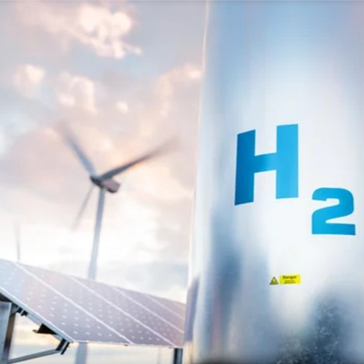


Opportunities with hydrogen
But in Switzerland, hydrogen has thus far only played a minor role. The discussions about transforming the Swiss energy system that took place at the Sustainability Days in Basel centred more on solar power, on accelerating the approval processes for wind power, and on integrating Switzerland’s systems into those of Europe. Pascal Vermaten, hydrogen expert at SPIE Deutschland & Zentraleuropa, gave a presentation on the fundamental opportunities and challenges associated with hydrogen.
 Using green hydrogen will be essential on the path to carbon neutrality. But in practice, hydrogen can only become a success if all of the different types of expertise required are properly coordinated.
Pascal Vermaten, hydrogen expert at SPIE Deutschland & Zentraleuropa
Characteristics of hydrogen
For hydrogen, especially hydrogen produced by electrolysing water, the main advantage in comparison with natural gas is clear at a glance: no carbon dioxide is emitted when hydrogen is used to generate energy.
When electrolysers are operated using renewable energy sources (solar, wind or geothermal), hydrogen production is entirely carbon-neutral – this is commonly referred to as green hydrogen. Hydrogen can also be produced from natural gas; in this case, it’s called grey or blue hydrogen. And for our neighbours in Switzerland and France, hydrogen produced using nuclear power for electrolysis (‘pink hydrogen’) also plays a role.
However, comparisons also show that hydrogen needs to be handled with considerable care due to its high combustibility and explosive range. In addition, hydrogen’s lower density needs to be considered when converting existing gas distribution networks and storage units.
SPIE provides support along the entire value chain
As a leading multi-technical service provider in the energy sector, SPIE can draw on extensive expertise all along the value chain. SPIE provides end-to-end support for its customers: planning and building electrolysis facilities (along with the required infrastructure), pipeline connections to supply networks, and IT-based maintenance of installed systems or specific areas such as production.
And in applying the technology, SPIE has the expertise needed to adapt industrial processes, mobility solutions or heating systems. This has been well demonstrated by the various projects SPIE has completed, such as remote monitoring of an LOHC (liquid organic hydrogen carrier) facility in Erlangen or the planning and conversion of gas pressure regulating and metering stations for the addition of hydrogen in production processes.
Across Europe, SPIE is helping more and more cities, public utilities and industrial customers to produce hydrogen with electrolysis, to make public gas networks fit to transport it in the future, and to reduce carbon emissions in production.